IYP X B. & M. Theocharakis Foundation, Athens
Weak Works | The Architecture of Christos Papoulias and His Friends
Curated by: Yorgos Tzirtzilakis and the architectural collective Askiseis Edafous (Kostas Efstathiou, Nikos Lamprou, Konstantinos Tsellos)
The B & M Theocharakis Foundation for the Fine Arts and Music presents an exhibition dedicated to the radical vision and work of architect and thinker Christos Papoulias, two years after his death. The exhibition traces Papoulias’ rich process of inquiry through the architect’s archive – as found in his home in Anafiotika – and his dialogue with selected works by his artist friends.
Christos Papoulias devoted himself to merging architecture, art, and topos, and it was this persistent and patient inquiry that led to his participation in major international art exhibitions (Documenta X in Kassel, the 48th Venice Biennale, Documenta 14 in Athens), while two of his most distinguished projects were acquired by the Centre Pompidou in Paris and are now part of its collections. Nevertheless, this body of work did not receive comparable recognition within Greece’s architectural culture.
Choosing from the outset not to follow the path of a conventional architect, Papoulias invites us to rethink architecture in the subtle manner of a “whisper of strategy,” which lends it a conceptual dimension and an ontological sense of existence. With “weak works”-as he writes in a handwritten note-he responds to the crisis of the dominant models of modernity by foregrounding the poetic intensity found in the infinite constellation of small, hidden fragments that shape a place.
The exhibition: The archive and the unarchivable
This is not a conventional architecture exhibition but rather a hybrid exhibition – workshop, an open field of research based on the architect’s extensive archival material, as preserved and passed on by Papoulias himself. Comprising drawings, sketches, models, handwritten notes, letters, newspaper clippings, photographs, books, magazines, and other objects, the archival material evokes Papoulias’ existential condition and his creative process in its unfolding, which is not to be equated with “method” understood as a rigid set of rules. What emerges is a continuous succession of incomplete traces of intentions, explorations, intersections, digressions, repetitions, or even the obsessions that gave rise to them – traces that remain open to experimentation, but also to refutation and failure.
Bearing the cryptic and elusive nature of the creative process, the body of this material-accessible yet “buried” in the crypt of the archive-returns, as he himself puts it, “to the land of the living, not exactly into the heart of that land but a little to the side, a little toward the edge.” In this way, it tends to transform into an “anarchive,” where the impossibility of classification-the unarchivable-places it in a state of tension between order and chaos, without imposing a one-dimensional interpretation.
The Friends’ Rendezvous (Au rendez-vous des amis)
Over the years, Papoulias cultivated an ongoing dialogue and collaborations with artists including Jannis Kounellis, Brice Marden, Michelangelo Pistoletto, Giorgos Hatzimichalis, George Lappas, Nikos Baikas, Mariella Simoni, Maria Papadimitriou, and Vasiliki Tsekoura; he engaged with the work of artists such as Giovanni Battista Piranesi, Richard Long, Mario Merz, and Juan Muñoz; and he developed his work in parallel with historians and critics of art and architecture including Denys Zacharopoulos, Catherine David, Harald Szeemann, Kenneth Frampton, Yehuda Safran, and the team of Tefchos magazine.
In The Friends’ Rendezvous, which is also the title of Max Ernst’s iconic painting, the works of his artist friends come together as the unconditioned Other needed to approach this inner world, even while remaining at its threshold, at the liminal point where distinctions fade. Framing the traces of this internal process, they form a place where one can encounter and attend to “weak works” – not because they are incomplete, “poor,” or inadequate, but because they are “full of doubts, with certain thoughts really personal.” A weakness essential for questioning and reflection, which becomes both a prerequisite and a driving force of contemporary architectural and artistic creation, precisely because it enables us to embrace life in all its unpredictable fluidity.
To mark the exhibition, Christos Papoulias’s long-out-of-print book, Hypertopos: Two Architectural Projects, which was first published as part of Documenta X in German and English (Reihe Cantz, 1998) and in a Greek translation (futura Publications, 1999), will be reissued. Accompanying events and public discussions will also be organized, along with a comprehensive exhibition catalogue conceived as a “work in progress”.
Works on view, apart from material from Christos Papoulias’s archive, are on loan from Centre Pompidou, Musée national d’art moderne – Centre de création industrielle, Paris, Irene Y. Panagopoulos Collection, Collection of the National Museum of Contemporary Art, Athens (ΕΜΣΤ), Christofis Collection, Dimitrios Antonitsis Collection / Hydra School Projects, as well as several other private collections.
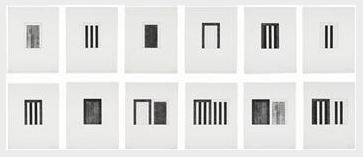
Marden Brice (1938-2023)
12 Views for Caroline Tatyana, 1977-1979
The complete set of twelve etchings with aquatint, on Arches paper, with full margins, all signed and numbered 41/50 in pencil
68.6 x 53.3 cm each
Edition 41/50 plus 13 AP’s