IYP X Core Athens Art Association, Athens
Idioms and other Idiosyncrasies
Curated by: Severin Dünser
The exhibition ‘Idioms and other Idiosyncrasies’ does not pursue a narrative theme, but rather presents a diversity of individual artistic positions. This heterogeneity is not representative of a local scene or contemporary art in general, but reflects the range of artistic vocabulary that will be presented in future exhibitions at Core. In contrast to future group shows, works are not thematically contextualised but addressed on an individual level. The exhibition is therefore a kind of keyword index – and, at the same time, a preview of things to come.
The sculptures, collages, ceramics, knitted works, drawings and photographs of Rosemarie Trockel (born 1952 in Schwerte, lives in Potsdam) are noted for their subtle social critique and range of subversive, aesthetic strategies including the reinterpretation of “feminine” techniques, the ironic shifting of cultural codes, a delight in paradox, and a refusal to conform to the commercial and institutional ideologies of the art system. Trockel‘s so-called ‘knitted’ pictures were first created in the early 1980s and were in part produced in response to the German art critic Wolfgang M. Faust‘s provocative comments that women were essentially unable to make art, acknowledging at best a connection between ‘women and weaving.’ Trockel took the gist of this ignorant remark and translated it into a series of knitted pictures that essentially metamorphosed this traditional house bound activity into the material of her art.
In ‘I seem to be a horse’, in a move that echoes both the supposedly abstract Rorschach paintings of Andy Warhol as well as the stain marks of numerous washing powder commercials that Trockel had appropriated in her ‘Fleckenbilder’ the artist has used the random patterns of Rorschach stains as an iconic motif or logo. At the same time the work‘s medium, deriving from the routine daily chores of many women sheds a gentle irony over Warhol‘s own ‚high art‘ appropriation of the Rorschach stains. Rorschach stains are, of course, often used to determine psychological disorder and in this, the work perhaps reflects Trockel’s famous statement that her art is always “interested not only in the history of the victor but also that of the weaker party”.
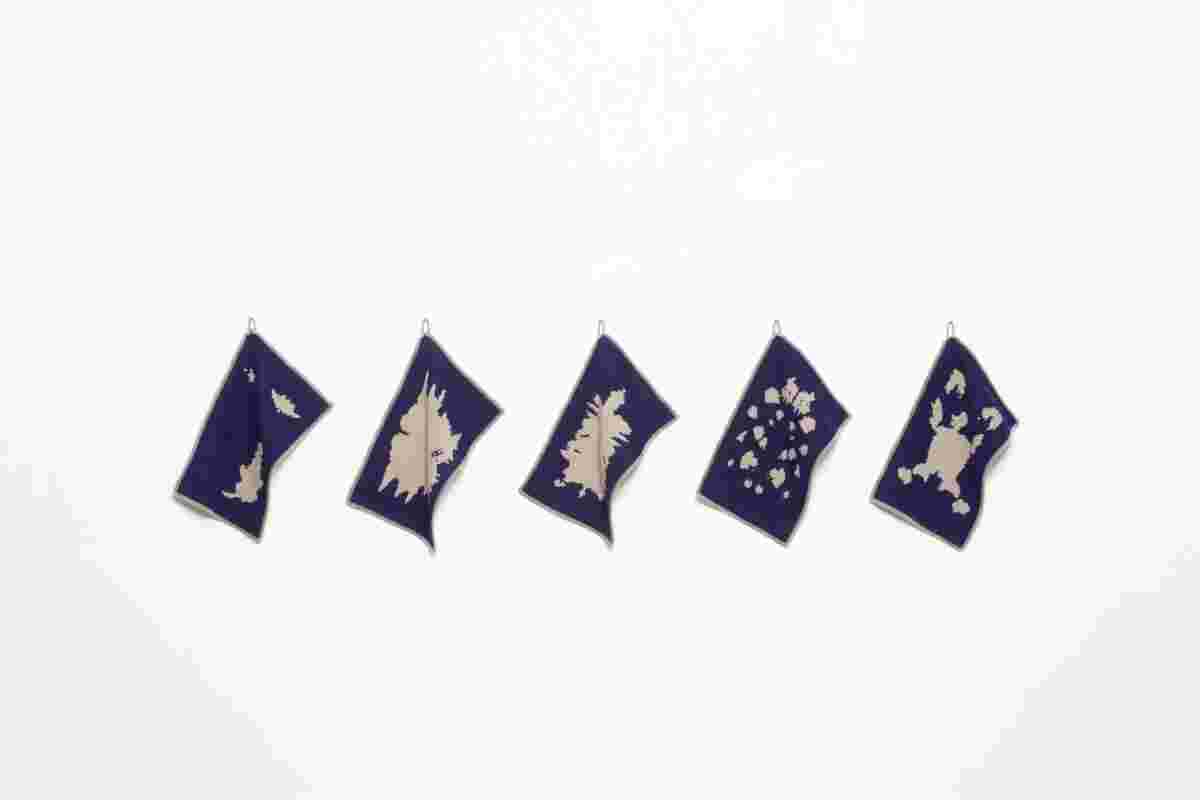
Trockel Rosemarie (b. 1952)
I seem to be a horse, 1992
Wool, 5 parts
34 × 20 cm each
Edition 9/25